The Complete Guide to AI in Recruitment
AI is reshaping recruitment with faster automation, smarter talent matching, and seamless workflows, while human recruiters remain essential for judgment, relationships, and final hiring decisions.
The "Man Plus Machine" Era:AI in Recruitment
Artificial Intelligence (AI) is no longer just a "future trend" it is the engine powering modern hiring. From automating mundane screening tasks to predicting candidate success, AI is reshaping how companies find talent.
But with this shift comes a wave of questions: Will AI replace recruiters? What are the real risks? And how does it actually improve hiring quality? This guide covers everything you need to know about the current state of AI in recruitment.The next hiring era is fully digital, intelligent, and automated. AI will reshape the recruitment landscape by eliminating manual tasks, streamlining workflows , and enabling recruiters to focus on strategy rather than repetitive activities.
Key Points of AI in Recruitment The Next Hiring Era
- Shift from manual screening to AI-powered candidate filtering
- Predictive hiring decisions using data and patterns
- Faster multi-channel sourcing with AI aggregation
- Automated communication and candidate engagement
- AI-driven workforce planning and forecasting
- Reduced time-to-hire and enhanced recruiter productivity
What Is AI in Recruitment?
AI in recruitment refers to technology that automates, enhances, and accelerates the hiring process. AI tools help identify the best candidates, understand CV patterns, create job descriptions, conduct interviews, and optimize hiring decisions based on real-time data.
Core Functions of AI Recruitment
- Automated resume parsing
- Candidate matching using machine learning
- AI-generated job descriptions and assessments
- Virtual interviewing and AI scoring
- Predictive analytics for better hiring outcomes
TL;DR/At-a-Glance Summary
Will AI in Recruitment Replace Human Recruiters?Speed (AI) & Strategy (Humans)
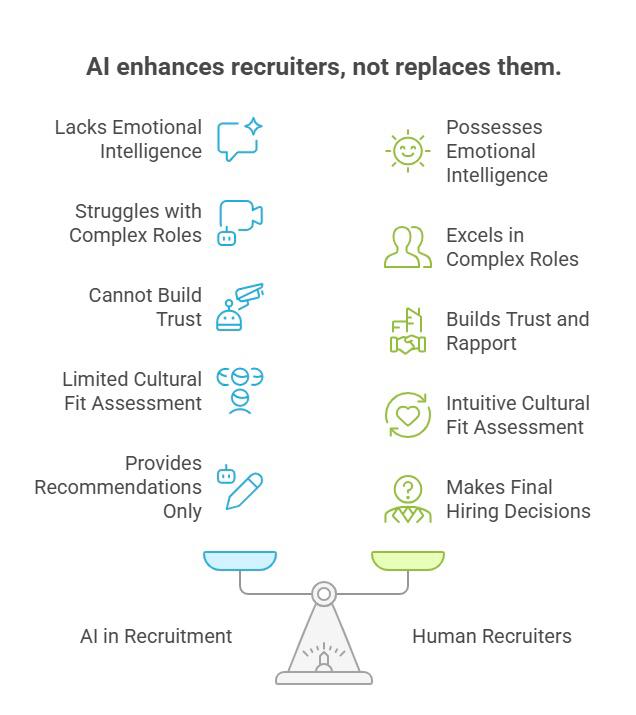
AI will not replace recruiters but it will replace manual tasks that slow them down. Human recruiters will remain essential for relationship-building, negotiation, final decision-making, and building employer branding.
| Feature | AI Capabilities | Human Recruiter Capabilities |
|---|---|---|
| Primary Role | Speed & Processing | Relationship Building & Strategy |
| Best For | Resume screening, Scheduling, Data Entry | Negotiation, Cultural Fit, Closing |
| Intelligence | Pattern Recognition | Emotional Intelligence (EQ) |
| Decision Power | Provides Scores & Recommendations | Makes the Final Hiring Decision |
| Weakness | Cannot build trust or read social cues | Limited bandwidth (can't read 1k resumes) |
The Key Benefits of AI in Recruitment
Why are 87% of companies adopting AI in hiring? Because the operational metrics are undeniable.
1. Faster Time-to-Hire
AI dramatically accelerates the "black hole" phases of hiring screening and scheduling.
The Stat: AI reduces time-to-hire by an average of 50%.
The Impact: You secure top talent before competitors do.
2. Higher Quality Matches
Traditional "Ctrl+F" keyword searches miss great candidates who use different terminology. AI matches based on skills and context.
The Stat: AI-driven interview analytics increase hiring accuracy by 40% .
The Benefit: Reduced turnover because candidates are a better technical fit from Day 1.
3. Reduced Hiring Costs
By automating high-volume tasks, teams can do more with less.
The Stat: Companies using AI tools report a reduction in recruitment costs by up to 30%.
The Benefit: Lower agency spend and reduced cost-per-hire.
4. Bias Reduction
Human recruiters often unconsciously favor candidates with familiar backgrounds. AI standardized scoring creates a level playing field.
The Stat: 68% of recruiters believe AI helps remove unconscious bias from the process.
Top Uses of AI in Recruitment
How do you actually implement this? Here are the practical applications you can start using today.
1. AI Talent Matching
Stop reading every resume. AI Talent Matching instantly identifies best-fit candidates by analyzing skills, experience, and role requirements.
How it works:
- Upload: You upload a Job Description (JD) and a batch of resumes.
- Analyze: The AI parses the JD to understand required skills (e.g., "Python" + "Data Analysis").
- Score: It ranks every candidate from 0–100% based on fit, not just keywords.
- Result: You only review the top 10% of applicants.
2. AI Video Interviewing
Automate the initial screening call. This tool conducts video, voice, or chat-based interviews and scores responses in real-time.
Step-by-Step Workflow:
- Candidate receives a link to an on-demand video interview.
- AI asks pre-set questions (e.g., "Describe a time you handled a conflict").
- Candidate records their answer.
- AI analyzes the transcript for key competencies and soft skills, providing a score to the recruiter.
3. Conversational JD Creation
Writing job descriptions is tedious. Conversational AI (like ChatGPT or Talsy's generator) can do it in seconds.
How to do it:
- Input: "I need a JD for a Senior React Developer in Chicago. Must have 5 years experience and leadership skills."
- AI Output: A fully formatted, SEO-optimized job description with responsibilities, requirements, and benefits.
4. Automated Onboarding
The drop-off rate between offer acceptance and Day 1 is high. AI streamlines this "pre-boarding" phase.
Workflow:
- AI automatically triggers a welcome email with digital document links.
- It verifies uploaded documents (ID, Tax forms) instantly.
- It creates a personalized training path based on the new hire's role.
Challenges in AI Recruitment: The Risks You Must Manage
1. Biased datasets can affect fairness:
AI may replicate existing hiring biases.
Solution: Use diverse, audited datasets and include human review.
2. High-quality training data is required:
Poor data reduces AI accuracy and predictions.
Solution: Standardize data collection and update datasets regularly.
3. Recruiters may resist technological change:
Some recruiters fear or avoid new AI tools.
Solution: Provide training and position AI as a support tool.
4. System integration issues:
AI may not sync well with existing HR tools.
Solution: Use platforms with strong integrations and unified dashboards.
5. Data privacy & compliance risks:
Candidate data must be handled securely.
Solution: Ensure encrypted data handling and compliance with privacy laws.
6. Misinterpreting AI insights:
AI insights may be misunderstood without expertise.
Solution: Combine AI analytics with human decision-making.
How Modern Platforms Solve AI Recruitment Problems
Solution to Bias in Data
Use AI platforms that apply ethical safeguards, unbiased scoring models, and transparent data audits. Modern recruitment systems, including what Talsy provides, use bias-detection layers to ensure fair and consistent candidate evaluation.
Solution to Integration Struggles
Adopt an all-in-one recruitment platform that connects sourcing, matching, interviewing, and onboarding in one place. Integrated ecosystems like Talsy help eliminate fragmented tools and reduce data inconsistency.
Solution to Candidate Trust Issues
Be transparent with candidates about how AI is used in the hiring process. Communicate clearly that AI assists with screening and analysis, while humans make the final decisions. Platforms such as Talsy support this by combining AI scoring with human-controlled approval steps.

Conclusion
The future of recruitment isn't "Man vs. Machine"it is "Man plus Machine."
Platforms like Talsy.ai are designed to handle the repetitive, high-volume tasks (The Core Functions) so that your recruiters can focus on what they do best: building relationships and closing top talent.FAQs
1. Will AI take over recruitmet ?
AI will automate tasks but will not replace recruiters. It enhances hiring by improving accuracy and speed.
2. What AI tools are most used in recruitment?
AI matching tools, resume parsers, AI interviews, JD generators, and chat-based candidate engagement tools.
3. How does AI improve hiring quality?
AI evaluates skills, patterns, and job fit more accurately than manual screening.
4. Can AI conduct interviews?
Yes, AI can conduct video, voice, and chat interviews with automated scoring and analytics.
5. How does Talsy.ai help recruitment teams?
Talsy provides AI talent matching, automated sourcing, JD creation, interviews, onboarding, and real-time analytics.
Tags
Neelekhana
Senior writer at Talsy, specializing in corporate strategy and industry insights.
Related Articles

Skills-Based Hiring: The Complete Guide (Process, Rubrics, Templates)
Skills-based hiring evaluates candidates using proof of ability work samples, simulations, and rubric-scored structured interviews instead of proxies like degrees, titles, or resume keywords, making hiring decisions more consistent and job-relevant.

How AI Is Changing the Recruiting Process in 2026
Discover how AI is transforming recruitment in 2026. Learn why skill gaps not AI drive hiring decisions and how Talsy.ai enables smarter, fairer hiring.

Ai in Employee Onboarding Software
AI in employee onboarding simplifies hiring with automation, personalization, and faster time-to-productivity creating a seamless, scalable onboarding experience from day one.